(1).jpg)
In tablet formulation, lubricants serve as one of the four essential excipient classes. Although used in relatively low proportions compared to fillers, binders, or disintegrants, lubricants provide vital benefits to final tablet properties, tablet compression processes, and machine longevity.
With advances in modern raw material manufacturing, an increasingly diverse range of lubricants is available, differing in nature, hydrophilicity/hydrophobicity, melting points, and cost. Selecting the appropriate lubricant optimizes the tablet formula and production process, enhancing product quality while extending industrial tooling life.
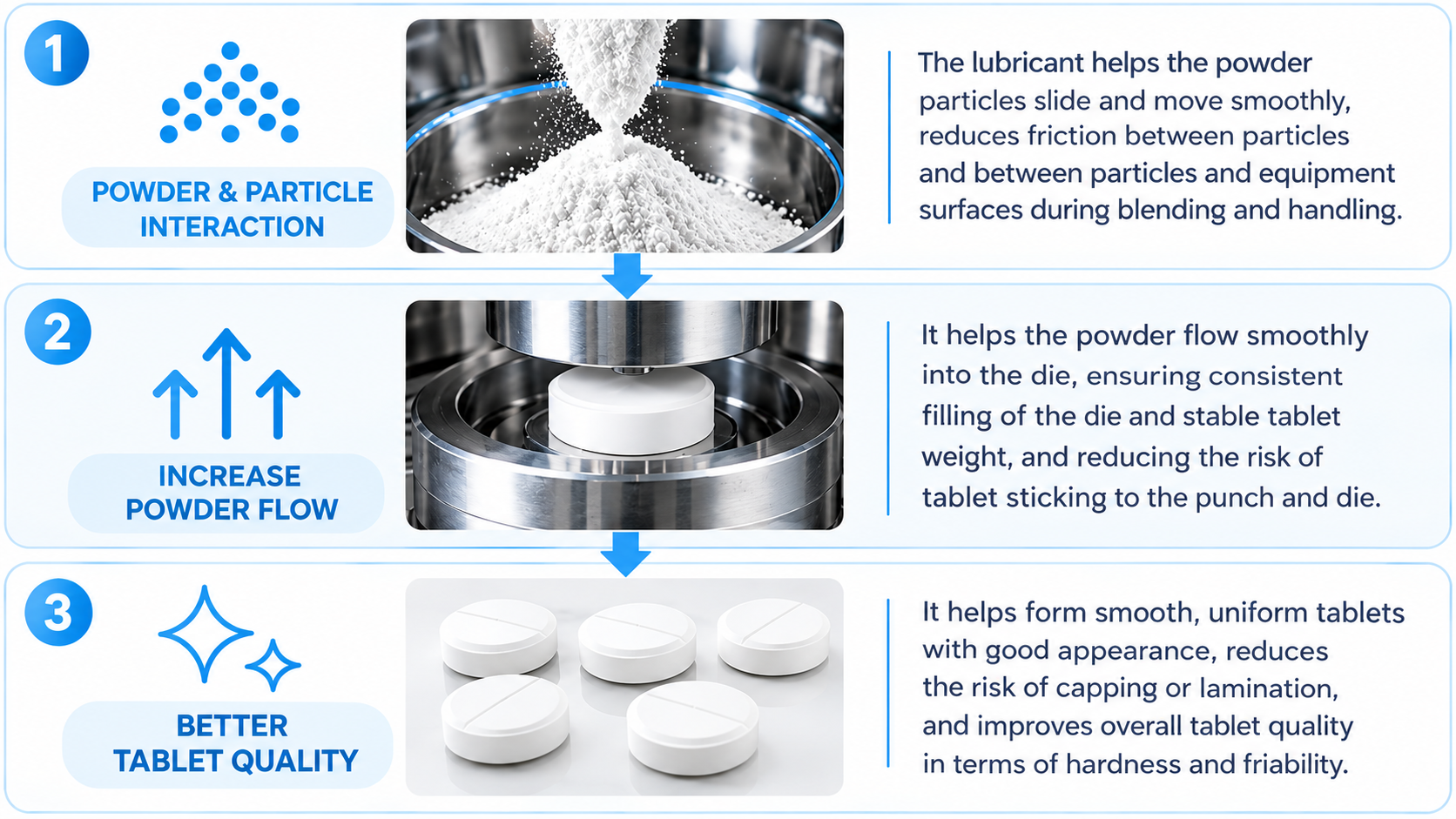
During the tablet compression cycle, lubricants act across multiple stages:
Although collectively referred to as lubricants, these agents are categorized by their primary functional roles:
Excipient Name | Primary Role | Properties | Recommended Usage |
|---|---|---|---|
Silicon dioxide | Glidant | Hydrophilic; available in various particle sizes and bulk densities. | 1 – 2% |
Magnesium stearate | Lubricant, Anti-adherent | Most commonly used lubricant.
High melting point (88 – 130°C).
Hydrophobic; may impede disintegration and dissolution.
Can reduce tablet hardness if overmixed.
Metallic taste.
Incompatible with certain active ingredients (e.g., PPIs). | 0.5 – 1% |
Sodium stearyl fumarate | Lubricant, Anti-adherent | Very high melting point (224 – 245°C).
More hydrophilic; minimal impact on disintegration and dissolution.
Less sensitive to overmixing regarding tablet hardness.
Rarely shows drug incompatibilities. | 0.5 – 1% |
Stearic acid | Lubricant, Anti-adherent | Moderate melting point (67 – 72°C).
Hydrophobic; can affect disintegration and dissolution.
Can reduce tablet hardness upon prolonged mixing. | 0.5 – 3% |
Glyceryl dibehenate | Lubricant, Anti-adherent | Low melting point (65 – 77°C).
Lipid-based excipient providing an attractive tablet gloss.
Minimal effect on tablet hardness. | 1 – 3% |
Hydrogenated castor oil | Lubricant, Anti-adherent | Moderate melting point (80 – 90°C).
Lipid-based excipient providing high gloss.
High stability; minimal effect on tablet mechanical strength.
Provides secondary binding properties. | 0.5 – 4% |
Hydrogenated vegetable oil | Lubricant, Anti-adherent | Low melting point (65 – 75°C).
Lipid-based excipient providing high gloss.
High stability; minimal effect on tablet mechanical strength.
Provides secondary binding properties. | 0.5 – 4% |
PEG 4000 / 6000 | Lubricant for effervescent and ODT tablets | Water-soluble lubricant.
Does not form an oily film upon dispersion.
Does not compromise disintegration or dissolution rates. | 1 – 3% |