Loading...
Loading...

Overview of Polyoxyl Castor Oil Excipient and Its Applications in Pharmaceutical Formulation

Polyoxyl castor oil is a group of excipients derived from polyoxyethylated castor oil, comprising non-ionic surfactants. This group of excipients is widely used in pharmaceutical formulation to improve solubility, assist emulsification, enhance permeability, and increase bioavailability for poorly water-soluble active pharmaceutical ingredients (APIs), showing particular effectiveness in liquid and semi-solid dosage forms

Mở/Đóng

    Banner Polyoxyl castor oil
    1. Classification of Common Polyoxyl Castor Oil Grades

    Based on the degree of hydrogenation and intended use, this group of excipients is typically categorized into several prominent grades in pharmaceutical formulas:

    • Polyoxyl 40 hydrogenated castor oil: A hydrogenated excipient grade, widely known in the market under the trade name Cremophor RH 40.
    • Polyoxyl 35 castor oil: A non-hydrogenated excipient grade, commonly known under the trade name Cremophor EL.
    • Polyoxyl 40 hydrogenated castor oil combined with Propylene glycol: This combination significantly improves co-solvency and enhances the stability of the drug dispersion system.

    2. Outstanding Physicochemical Characteristics

    Outstanding Physicochemical Characteristics
    • Appearance: Depending on the specific type and batch, this excipient can appear as a clear, colorless liquid or slightly hazy with a hue ranging from pale yellow to white. A common characteristic is that they are odorless and tasteless, thus avoiding any adverse impact on the organoleptic properties and flavor of the finished product unlike some other surfactants (e.g., Tween, Span).
    • Solubility: In general, this group of excipients is very soluble in water, freely soluble in alcohol and ethyl acetate, but completely insoluble in mineral oil.
    • Rheological Properties: Exhibits very mild viscosity, providing convenience and ease of handling during pharmaceutical processing processes.
    • Stability and Compatibility: Highly stable and resistant to rancidity when stored under recommended conditions. Furthermore, excipients exhibit good compatibility, typically avoiding precipitation when incorporated into formulas containing salts, acids, or electrolytes.
    • HLB Value: Generally possesses a high HLB value (ranging from 14 to 17). This factor makes them ideal oil-in-water (O/W) emulsifiers for many poorly soluble drugs.

    3. Mechanism of Action and Solubilization

    Mechanism of Action and Solubilization
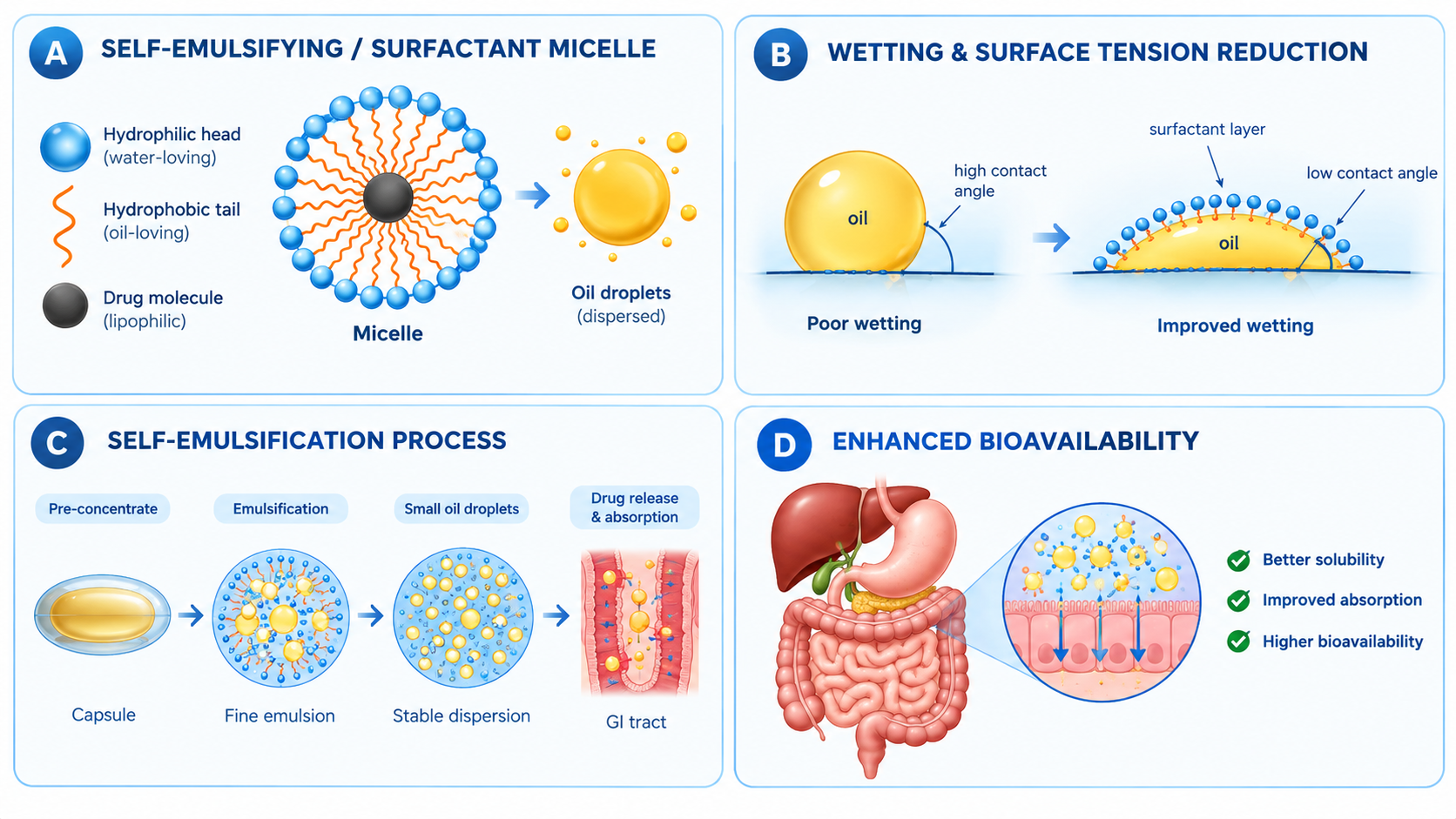
    • Solubilization via Micelle Formation: With an amphiphilic structure consisting of a hydrophobic portion (from castor oil) and a hydrophilic polyoxyethylene chain, the excipient molecules self-assemble into micelle structures when dispersed in water at appropriate concentrations. Poorly soluble drugs are retained and solubilized inside the hydrophobic core of the micelle, thereby increasing apparent solubility in aqueous media.
    • Dispersion and Wetting Improvement: By reducing surface tension (decreasing the contact angle) between the drug and the solvent medium, the excipient improves the wetting capacity of particles, promoting easier dispersion processes.
    • Microemulsion Support: When applied in self-emulsifying or microemulsion systems, they stimulate the formation of ultrafine oil droplets. Expanding this contact surface area is vital for improving drug dissolution and absorption rates.
    • Impact on Biological Membranes: Some studies have noted the capacity of this excipient to influence biological membrane permeability and inhibit P-glycoprotein pumps. This mechanism may contribute to increased oral bioavailability for certain hard-to-absorb drugs.

    4. Specific Applications in Formulation Systems

    • As a Solubilizing Excipient: Helps improve aqueous solubility for poorly soluble drugs, especially useful in syrup formulas to boost dissolution and bioavailability.
    • As an Emulsifier: Supports the emulsification of hydrophobic components (such as fatty acids, fatty alcohols, mineral oils) within pharmaceutical emulsion systems.

    a. Specialized Applications of the Hydrosol® Series:

    • Enhances permeability and uniform dispersion capacity of drugs in suspension formulas.
    • Acts as an agent to help mask unpleasant tastes for certain drugs in liquid medicines.
    • Slows down the evaporation process of essential oils and alcohol, thereby limiting alcohol content reduction and preventing active ingredient precipitation.
    • In topical preparations, Hydrosol® increases film-forming capacity, eliminates stickiness and oil-phase flaking, providing a smooth skin feel for the product.

    b. Reference Application Examples

    Based on practical formulation experience, below are examples of excipient-drug pairs commonly recommended for combined use:

    • Polyoxyl 40 hydrogenated castor oil: Suitable for Vitamin A, Vitamin D, and Vitamin E.
    • Polyoxyl 35 castor oil: Suitable for Vitamin A, Vitamin D, and Vitamin E.
    • Polyoxyl 40 hydrogenated castor oil + Propylene glycol mixture: Suitable for dissolving active ingredients such as Paracetamol, Bromhexine HCl, Ambroxol HCl, Dextromethorphan HBr, and Cyproheptadine.
    • Chia sẻ qua viber bài: Overview of Polyoxyl Castor Oil Excipient and Its Applications in Pharmaceutical Formulation
    • Chia sẻ qua reddit bài:Overview of Polyoxyl Castor Oil Excipient and Its Applications in Pharmaceutical Formulation

    Bài viết liên quan

    Beta Cyclodextrin Crucial Role In Herbal Formulation

    Discover the application of Beta Cyclodextrin in improving solubility, increasing bioavailability, and effectively masking the bitter taste of herbal active ingredients.

    Discover the Role of Boric Acid as a Pharmaceutical Excipient and pH-Adjusting Agent

    Explore boric acid applications in pharmaceutical formulation, including its physicochemical properties, use in ophthalmic preparations and borate buffer systems, and key safety considerations.

    Milk Thistle Dry Extract - Silymarin-rich extract supporting liver protection and detoxification

    Learn about Milk Thistle Dry Extract. Discover the mechanism of the active ingredient Silymarin, its advantages, and applications in liver detoxification and hepatocyte protection

    Tyloxapol Versatile excipient and non-ionic surfactant for pharmaceuticals

    Learn what Tyloxapol is. Discover the mechanism, advantages, and applications of the non-ionic surfactant Tyloxapol in eye drops, aerosols, and nano systems.

    Softgel Capsules and Strategies to Prevent Gelatin Cross-Linking

    Explore softgel capsule formulation, gelatin shell cross-linking mechanisms, key causes, effects on drug release, and strategies to improve capsule stability and disintegration.

    Overview of components and quality regulations of injectable raw materials

    Explore injectable drug formulation, key excipient functions, solvents, solubilizers, tonicity agents, buffers, preservatives, antioxidants, and essential quality requirements for sterile injectable preparations.

    Mở/ĐóngMở/Đóng