(9).png)
1. The Role of Taste-Masking Film Coating in Pharmaceutical Formulation
- Among the various methods used to mask the bitter taste of active pharmaceutical ingredients (APIs), taste-masking film coating is a widely used technique to improve the acceptability of oral medications, enhance patient compliance, and support therapeutic effectiveness. It is particularly suitable for medications intended for pediatric and elderly patients, as well as rapidly dissolving dosage forms.
- Film coating creates a physical barrier that prevents the API from coming into direct contact with saliva for a short period while the drug remains in the oral cavity, thereby reducing or eliminating the perception of bitterness.
- The principle of taste-masking film coating is based on two main mechanisms:
- Formation of a diffusion barrier: This is the most common mechanism. The film coating is insoluble or dissolves very slowly in saliva, preventing the API from diffusing out during the first 30–60 seconds in the oral cavity. The API then begins to be released when the dosage form reaches the stomach.
- Control of dissolution rate: The film coating is designed with an appropriate dissolution rate, allowing it to dissolve slowly at salivary pH (~6.8) and more rapidly in gastric fluid (pH ~1.2). As a result, the API does not reach a sufficient concentration in the oral cavity to trigger the perception of bitterness.
2. Advantages and Disadvantages of Taste-Masking Film Coating Compared with Other Bitter Taste-Masking Methods
Advantages:
- Easy to implement using conventional equipment and machinery available in pharmaceutical manufacturing facilities.
- Does not require investment in new equipment or technologies.
- Does not alter the chemical nature of the API, thereby reducing the risk of changes in chemical stability and minimizing potential incompatibilities.
- Highly effective for many bitter APIs, including clarithromycin, cetirizine, dextromethorphan, and diphenhydramine.
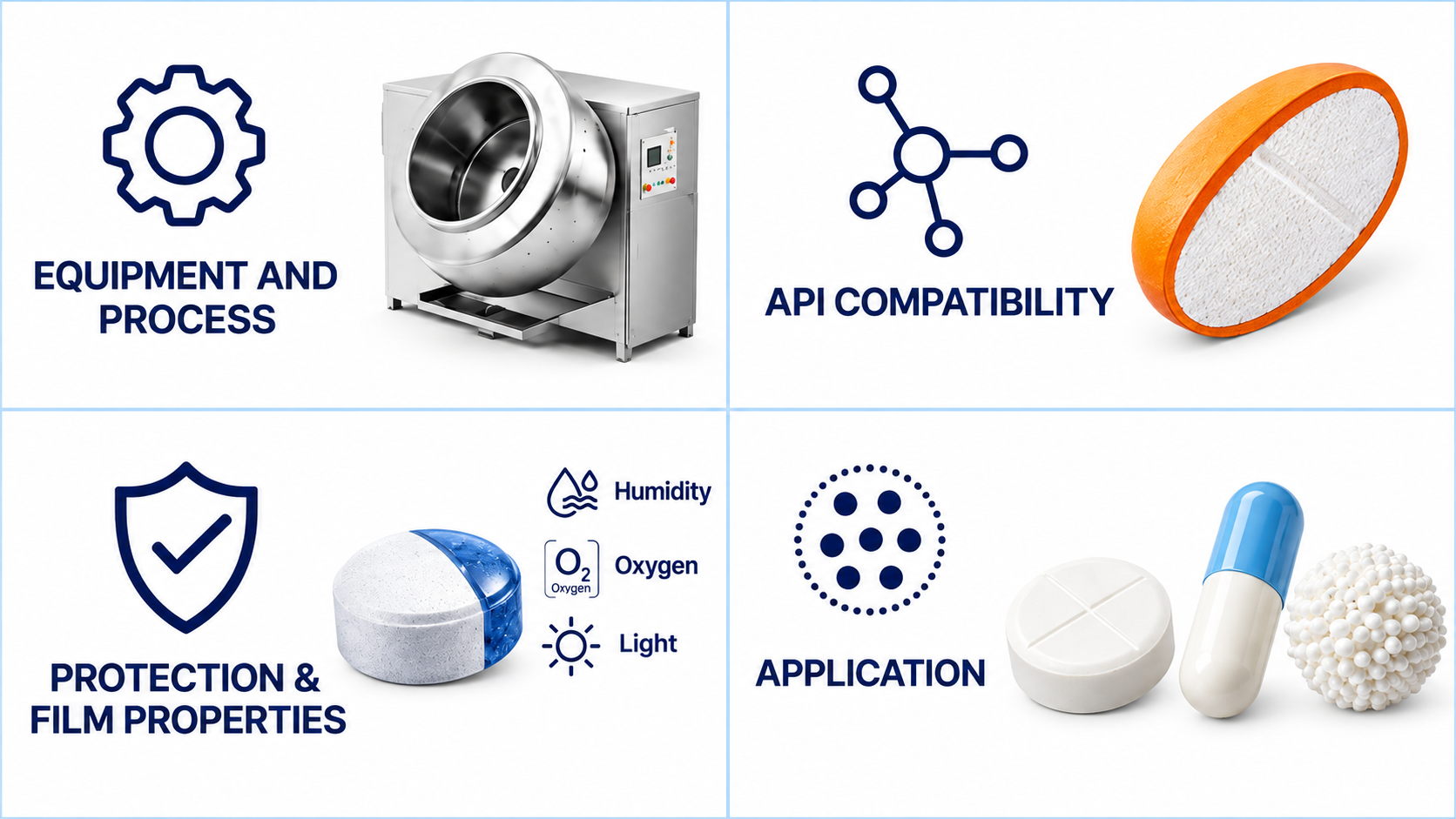
- The film coating also helps protect the tablet core from environmental factors such as oxygen, moisture, and light, while improving the tablet's appearance.
- Does not significantly increase tablet size, as the film coating accounts for only approximately 3–5% of the tablet weight.
- Allows flexible adjustment of the coating formulation, including polymer type, film thickness, and film permeability.
Disadvantages:
- Less effective for highly insoluble and intensely bitter APIs, such as quinine and levocetirizine.
- May delay API dissolution.
- Not suitable for chewable tablets, orally disintegrating tablets (ODTs), or powders and sachets intended for suspension preparation.
- The effectiveness of the film-coating process depends significantly on the experience and technical expertise of the formulator.
- Risk of film cracking or breakage, which may result in bitterness being perceived by patients.
3. Polymers Commonly Used in Taste-Masking Film Coating
.png)
Polymers commonly used in taste-masking film coating include water-insoluble or poorly water-soluble polymers such as ethyl cellulose, methacrylate copolymers, cellulose acetate, and shellac. In addition, water-soluble polymers such as HPMC and PVA can also be used.
- Among these, methacrylate copolymers are one of the most widely used polymers for this application, offering the following advantages:
- Good solubility in ethanol, isopropyl alcohol, and acetone, while being insoluble in water.
- Dissolves well at pH < 5.0; insoluble at oral pH ???? provides good masking effect while ensuring active ingredient release in the stomach.
- Dissolves readily in the stomach, reducing the risk of delaying API dissolution.
- Forms films with good mechanical properties, providing tablets with an attractive glossy appearance, improved swallowability, and strong adhesion between the coating layer and the tablet core.
- High masking ability requires only a low coating weight gain ???? saving time, materials, and costs.
- Low viscosity, facilitating coating solution preparation and the film-coating process while reducing the risk of spray nozzle clogging.
- Compatible with a wide range of APIs and excipients.
- Regulated in USP/NF and Ph.Eur monographs ???? convenient for product registration.