Tablets are solid pharmaceuticals, with a specific shape, each containing a precise amount of one or more active ingredients, formed by compressing a volume of powder or drug granules with or without excipients on a tablet press. Tablets are the leading common dosage form, accounting for nearly 2/3 of the pharmaceuticals circulating on the market. This popularity is primarily due to the convenience of use and suitability in formulation research, production, transportation, and storage, as well as the convenience of use for patients. Film coating, also known as thin film coating, is the process of covering the surface of a tablet core with a very thin excipient film. The composition of this film coating layer typically includes a film-forming agent (polymer), solvent, plasticizer, opacifier, colorant, and other excipients depending on the intended use. The film coating is applied to solid dosage forms for various purposes to help maintain the physical and chemical integrity of the active ingredient, including enhancing the stability of the drug by creating a physical barrier against environmental storage conditions (light, oxygen, or water vapor).
(2).jpg)
Depending on their physicochemical properties, different polymers will create a barrier with different effectiveness against moisture. In moisture barrier film coating, the type of polymer and the usage ratio will be selected based on the water resistance characteristics that the polymer provides, as well as the hygroscopic properties of the active ingredient used. Below is a statistical table of some commonly used polymers in moisture barrier film coatings along with their corresponding usage ratios.
Polymer Classification | Common Polymers |
Water-soluble polymers | HPMC (Hydroxypropyl methylcellulose or Hypromellose) |
HPC (Hydroxypropyl Cellulose) | |
PVP (Polyvinyl Pyrrolidone), | |
PVA (Polyvinyl Alcohol) | |
Chất đồng trùng hợp PVA–PEG (PVA–PEG copolymer) | |
Water-insoluble polymers | Polyvinyl acetate |
| Ammonio methacrylate | |
EC (Ethyl cellulose) | |
Intestinal pH-dependent soluble polymers | Shellac |
| Methacrylic acid copolymer |
Depending on their physicochemical properties, different polymers will create a barrier with different effectiveness against moisture. In moisture barrier film coating, the type of polymer and the usage ratio will be selected based on the water resistance characteristics that the polymer provides, as well as the hygroscopic properties of the active ingredient used. Below is a statistical table of some commonly used polymers in moisture barrier film coatings along with their corresponding usage ratios
Polymer Type | Typical Concentration in the Film Coating Suspension | Solvent |
HPMC | 2 – 20% | Ethanol/Purified Water |
HPC | Approximately 5% | Ethanol/Purified Water |
PVP | 0,5 – 5% | Ethanol/Purified Water |
PVA | 20 - 55% | Purified Water |
For moisture barrier film coating, the film thickness or theoretical weight gain must be determined to ensure the function of the film coating layer and must be determined experimentally. The thickness of the coating film remains an important factor when it comes to the moisture resistance of the film. Increasing the thickness helps prolong the disintegration time and improves the tensile strength of the tablet core. However, it must be ensured that increasing the weight of the film coating layer (film thickness) will not increase the disintegration or dissolution time of the coated tablet. The weight gain ratio for moisture barrier film coatings is typically 5%.
.jpg)
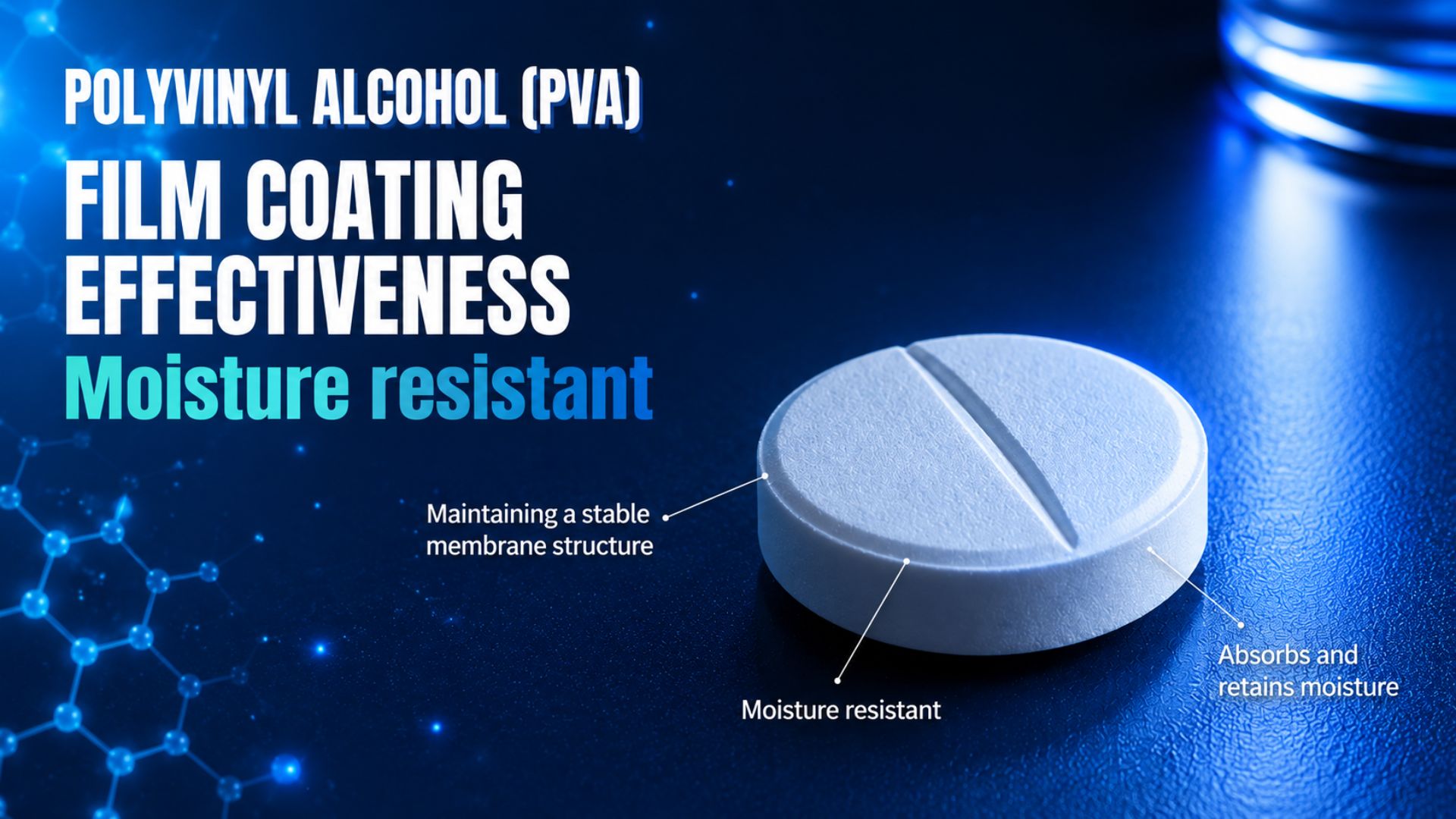
One of the common polymers for moisture barrier film coating purposes is PVA. PVA is a water-soluble synthetic polymer, with a molecular weight ranging from 40,000 to 600,000 Daltons and is a non-toxic, thermally stable polymer. The ratio of PVA used is usually in the range of 25% to 55% of the total solid mass of the coating solution. The moisture barrier mechanism of the PVA film coating layer is that this polymer acts as a moisture barrier involving the process of water absorption, followed by water retention via hydrogen bonds, preventing the further penetration of water into the tablet core. This phenomenon is due to the higher degree of crystallinity of PVA compared to HPMC, which helps prevent the diffusion of water molecules across the membrane. At the same time, the coating layer using PVA also exhibits increased film adhesion compared to the coating layer using cellulose derivatives. While for cellulose derivatives like HPMC or HPC, moisture can penetrate quickly and move deeper into the tablet, thereby increasing the risk of causing the degradation of moisture-sensitive drugs.
.jpg)
Water vapor molecules are transmitted across the membrane in three steps:
The HPMC film shows higher water vapor permeability because water molecules can interact with hydrophilic groups within the membrane and act as a plasticizer. From there, moisture can move deeper into the tablet core. The combination of HPMC with HPC helps improve the adhesion of the coating film to the tablet core, reducing the gaps between the tablet core and the film, giving moisture fewer pathways to penetrate deep and affect the tablet core inside. PVA provides better adhesion and potential advantages in film strength as well as moisture resistance due to its higher degree of crystallinity than HPMC, which helps prevent the diffusion of water molecules. Thus, it can be seen that PVA creates a film coating layer with an effective moisture barrier mechanism, suitable for protecting moisture-sensitive active ingredients such as aspirin, clavulanic acid, acetylsalicylic acid, ranitidine, vitamin C, enalapril, herbal extracts,... Besides, the PVA film layer provides good mechanical strength, high stability, and does not affect the release of the active ingredient.