Loading...
Loading...

Methacrylic acid co-polymer and applications in enteric-coated tablets

Methacrylic acid co-polymer is a group of excipients derived from methacrylic acid. This group of excipients is widely used in pharmaceutical formulation to create enteric film coatings, helping to protect the active ingredient intact in the stomach and ensure effective release when the drug reaches the desired site of action in the duodenum or small intestine

Mở/Đóng

    Introduction to Methacrylic acid co-polymer
    1. Introduction to Methacrylic acid co-polymer

    Methacrylic acid co-polymer is the common name for a group of polymers derived from methacrylic acid, with its main application in pharmaceutical formulation being a polymer that creates enteric film coatings. Some commonly used derivatives of methacrylic acid include:

    • Methacrylic acid & Methyl methacrylate co-polymer
    • Methacrylic acid & Ethyl acrylate co-polymer

    2. Properties of methacrylic acid derivative excipients in enteric film coating

    • Soluble at pH greater than 5.5, therefore suitable for enteric film coating applications, helping the film coat remain intact at stomach pH and ensuring the release of the active ingredient when the tablet reaches the desired site of action, which is the duodenum/small intestine.
    • Highly soluble in alcohol, methanol, isopropyl alcohol, and acetone.
    • Insoluble but well-dispersed in water.

    3. Advantages and dosage forms of methacrylic acid derivative excipients
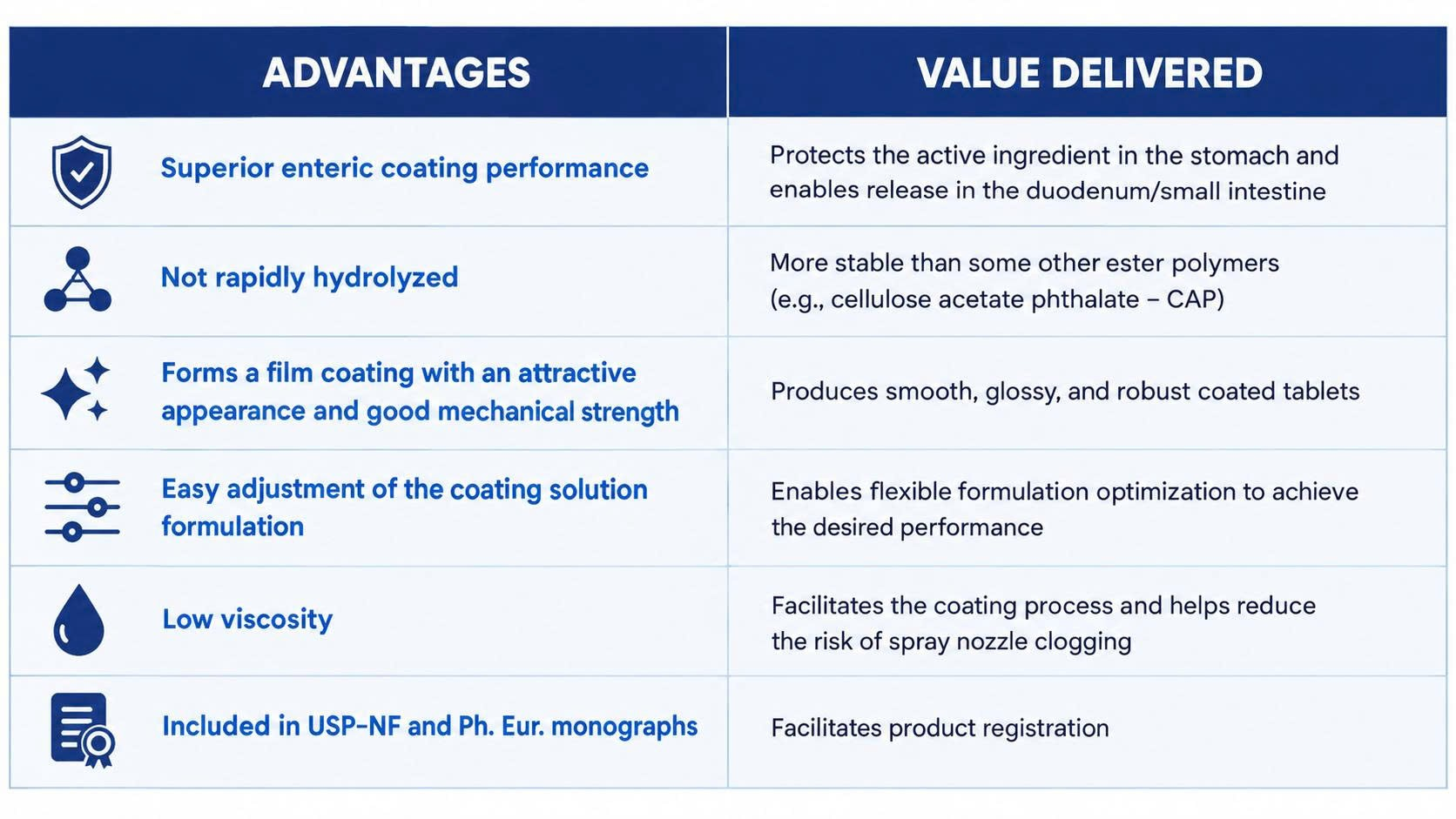
    Advantages and dosage forms of methacrylic acid derivative excipients

    • It is the most popular excipient line today for enteric film coating applications, offering good protection for active ingredients in the stomach and good release in the duodenum/small intestine.
    • Not rapidly hydrolyzed like some other ester polymers (e.g., cellulose acetate phthalate – CAP).
    • Creates a film coating with a good visual appearance and good mechanical strength.
    • Easy to adjust the film coating formulation.
    • Low viscosity, convenient for the film coating process, limiting the risk of spray gun clogging.
    • Regulated in USP/NF and Ph. Eur monographs, convenient for the product dossier registration process.

    Methacrylic acid derivative excipients are usually produced in powder form or ready-to-use suspension form with a suitable solvent (usually water). Each form brings its own advantages depending on the product and the desired process of the formulator:

    • Powder form: convenient for storage; easy to adjust and change formulations; diverse choices of suitable solvents (water or alcohol-water mixtures).
    • Ready-to-use suspension form with water: saves time and effort for the process of dispersing the polymer in water; using water helps limit the risk of residual solvents and the risk of explosion during production.
    • Chia sẻ qua viber bài: Methacrylic acid co-polymer and applications in enteric-coated tablets
    • Chia sẻ qua reddit bài:Methacrylic acid co-polymer and applications in enteric-coated tablets

    Bài viết liên quan

    Beta Cyclodextrin Crucial Role In Herbal Formulation

    Discover the application of Beta Cyclodextrin in improving solubility, increasing bioavailability, and effectively masking the bitter taste of herbal active ingredients.

    Discover the Role of Boric Acid as a Pharmaceutical Excipient and pH-Adjusting Agent

    Explore boric acid applications in pharmaceutical formulation, including its physicochemical properties, use in ophthalmic preparations and borate buffer systems, and key safety considerations.

    Milk Thistle Dry Extract - Silymarin-rich extract supporting liver protection and detoxification

    Learn about Milk Thistle Dry Extract. Discover the mechanism of the active ingredient Silymarin, its advantages, and applications in liver detoxification and hepatocyte protection

    Tyloxapol Versatile excipient and non-ionic surfactant for pharmaceuticals

    Learn what Tyloxapol is. Discover the mechanism, advantages, and applications of the non-ionic surfactant Tyloxapol in eye drops, aerosols, and nano systems.

    Softgel Capsules and Strategies to Prevent Gelatin Cross-Linking

    Explore softgel capsule formulation, gelatin shell cross-linking mechanisms, key causes, effects on drug release, and strategies to improve capsule stability and disintegration.

    Overview of components and quality regulations of injectable raw materials

    Explore injectable drug formulation, key excipient functions, solvents, solubilizers, tonicity agents, buffers, preservatives, antioxidants, and essential quality requirements for sterile injectable preparations.

    Mở/ĐóngMở/Đóng