Learn about HP-β-CD (Hydroxypropyl-β-cyclodextrin), a leading excipient for improving solubility and stability and reducing toxicity risks in injectable formulations.
1. Origin and characteristics of Hydroxypropyl-β-cyclodextrin
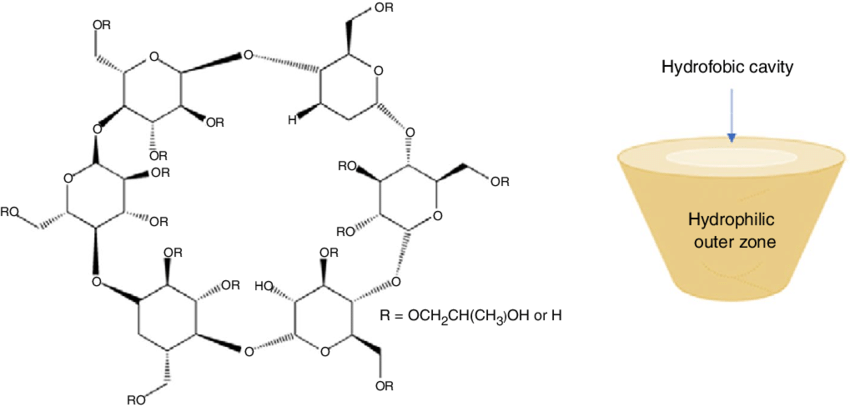
Hydroxypropyl-β-cyclodextrin (HP-β-CD) is a semi-synthetic derivative of β-cyclodextrin, produced by introducing hydroxypropyl groups onto the hydroxyl groups of the β-cyclodextrin molecule. This structural modification significantly improves water solubility, reduces renal toxicity, and minimizes crystallization compared with native β-cyclodextrin.
Structure of 2-hydroxypropyl-β-cyclodextrin (on the left) and its... | Download Scientific Diagram
Due to its ability to form inclusion complexes with many poorly water-soluble active pharmaceutical ingredients (APIs), HP-β-CD is one of the most widely used excipients in injectable formulations. It helps improve solubility and chemical stability for hydrophobic APIs without requiring large amounts of organic solvents or surfactants.
HP-β-CD is currently used in numerous pharmaceutical products accepted by regulatory agencies such as the FDA and EMA, with various commercial products marketed worldwide.
2. Structure and physicochemical properties of HP-β-CD
HP-β-CD retains the characteristic truncated cone-shaped structure of cyclodextrins, consisting of:
A hydrophobic inner cavity
A hydrophilic outer surface
An average molecular weight of approximately 1,300–1,500 Da, depending on the degree of hydroxypropyl substitution.
The introduction of hydroxypropyl groups provides several advantages:
Increases water solubility from approximately 18 mg/mL for β-CD to over 500–600 mg/mL.
Reduces the tendency to crystallize.
Reduces interactions with membrane cholesterol.
Lowers the risk of renal toxicity.
Makes it suitable for injectable and intravenous formulations.
3. Mechanism of HP-β-CD inclusion complex formation
The hydrophobic cavity of HP-β-CD can accommodate part or all of a hydrophobic API molecule through non-covalent interactions.
API + HP-β-CD ⇌ API–HP-β-CD complex
Other Cyclodextrin Series – CD Bioparticles
This process maintains the API in equilibrium between its free and complexed forms. After administration, the complex can dissociate as the API is absorbed or distributed, releasing the active ingredient to exert its therapeutic effect.
4. Why choose HP-β-CD for injectable formulations?
Improved apparent solubility: For APIs with very low aqueous solubility, HP-β-CD can substantially increase the amount of dissolved drug. This mechanism helps reduce precipitation, increase dissolved API concentrations, maintain solution clarity, and improve bioavailability for injectable products. Solubility enhancement may range from several-fold to hundreds-fold, depending on the API's chemical structure and the complex formation constant.
Protection against degradation and improved injectable stability: When an API is included within the cyclodextrin cavity, the encapsulated portion may have reduced exposure to oxygen, light, moisture, and metal ions, helping protect and stabilize sensitive APIs in injectable formulations. This may contribute to an extended shelf life.
Reduced irritation at the injection site: By partially including the API within the HP-β-CD cavity, the amount of free API directly exposed to tissues may be reduced. This can help minimize tissue irritation, injection pain, and the risk of API precipitation at the injection site.
Reduced need for organic solvents: HP-β-CD can reduce or substantially eliminate the need for solubilizing cosolvents such as ethanol, propylene glycol, polyethylene glycol, and benzyl alcohol, potentially reducing solvent-related pain, irritation, and toxicity.
Improved biocompatibility: HP-β-CD has lower hemolytic potential and lower renal toxicity than native β-CD. It is generally well tolerated when used at appropriate doses and is included in various approved injectable medicines.
Compatibility with other excipients: HP-β-CD is compatible with many APIs and excipients, supporting injectable formulation optimization.
5. Current applications of HP-β-CD in pharmaceutical formulations
HP-β-CD is used in injectable formulations for the following purposes:
Improving solubility
Protecting and stabilizing APIs
Reducing irritation and injection pain
Extending product shelf life
Beyond intravenous injections, HP-β-CD is also used in:
Intramuscular injections
Subcutaneous injections
Sterile ophthalmic solutions
Lyophilized injectable formulations
Biopharmaceutical formulations requiring API stabilization
Some APIs that may benefit from HP-β-CD include:
API
Role of HP-β-CD
Voriconazole
Improves solubility and can reduce the need for organic solvents
Ziprasidone mesylate
Improves solubility and stability
Aripiprazole
Supports solubilization in injectable formulations
Itraconazole
Improves solubility and may enhance bioavailability
Diclofenac
Supports solubilization and may help reduce irritation
Dexamethasone
Supports solution stability and improves solubility
Hydrocortisone
Supports the preparation of clear injectable solutions
Discover the application of Beta Cyclodextrin in improving solubility, increasing bioavailability, and effectively masking the bitter taste of herbal active ingredients.
Pure ethanol is an indispensable organic solvent in pharmaceutical manufacturing. Discover the outstanding applications and strict standards of pharmaceutical ethanol.
Learn in detail about sucrose excipients in pharmaceutical preparations. Explore the properties, advantages, and applications of sucrose in manufacturing tablets and liquid medications.
Explore boric acid applications in pharmaceutical formulation, including its physicochemical properties, use in ophthalmic preparations and borate buffer systems, and key safety considerations.
Learn about Milk Thistle Dry Extract. Discover the mechanism of the active ingredient Silymarin, its advantages, and applications in liver detoxification and hepatocyte protection
Learn what Tyloxapol is. Discover the mechanism, advantages, and applications of the non-ionic surfactant Tyloxapol in eye drops, aerosols, and nano systems.
Biorich Group
Thông tin
Biorich Group provides raw materials and supply chain solutions for the pharmaceutical, nutrition, healthcare, cosmetics, food, and industrial sectors, with a global network of partners.
Main category
Loading...
Featured videos
Sign up to receive news
Sign up for our weekly newsletter to get the latest updates.
(7).png)