(7).png)
1. General introduction to ethanol as a solvent
Ethanol (ethyl alcohol, C₂H₅OH) is one of the most widely used organic solvents in the pharmaceutical industry due to its ability to dissolve many active pharmaceutical ingredients (APIs), suitable volatility, high compatibility with various APIs and excipients, and well-established safety profile. In pharmaceutical manufacturing, ethanol serves not only as a solvent but also plays an important role in several processes, including herbal extraction, wet granulation, film-coating solution preparation, equipment disinfection, and the formulation of modern drug delivery systems.
Depending on the intended application, ethanol is available at various concentrations. Among these, high-purity ethanol at 96–100% is preferred for pharmaceutical manufacturing due to its low water content, high purity, and ability to meet stringent international pharmacopoeial standards.
2. Key roles of ethanol as a solvent in pharmaceuticals
a. Ethanol as a solvent for active ingredients and excipients
- Ethanol is an effective solvent for many active ingredients that are poorly soluble or insoluble in water, particularly:
- Fat-soluble vitamins.
- Steroids.
- Essential oils.
- Alkaloids.
- Flavonoids.
- Certain lipophilic active ingredients.
- In addition to active ingredients, ethanol is used to dissolve various excipients, such as film-forming polymers, plasticizers, flavoring agents, and preservatives, before incorporating them into formulations.
Some dosage forms that use ethanol include:
- Oral solutions.
- Oral drops.
- Nasal sprays and throat sprays.
- Topical preparations.
- Gels and topical solutions.
b. Ethanol as an effective solvent for extraction processes
- One of the most important applications of ethanol is the extraction of bioactive compounds from medicinal plants.
- Compared with water, ethanol can dissolve a broader range of active compounds, including:
- Polyphenols.
- Flavonoids.
- Curcuminoids.
- Alkaloids.
- Glycosides.
- Coumarins.
- Terpenoids.
- By adjusting ethanol concentration (e.g., 50%, 70%, 80%, or 96%), manufacturers can optimize extraction yield and improve selectivity for specific target compounds.
c. The role of ethanol in wet granulation for tablet manufacturing
- In wet granulation, ethanol is commonly used as a solvent to prepare binder solutions, such as:
- Povidone (PVP).
- Hypromellose (HPMC).
- Ethyl cellulose.
- Copovidone.
- For active ingredients that are sensitive to water, ethanol can help to:
- Reduce the risk of hydrolysis.
- Shorten drying time.
- Promote uniform granule formation.
- Improve granule flowability.
d. Solvent for Tablet Film-Coating Solutions
- Many film-coating formulations use ethanol to dissolve film-forming polymers, such as:
- Shellac.
- Ethyl cellulose.
- Acrylic polymer derivatives.
- Taste-masking coating polymers.
- Due to its rapid evaporation rate, ethanol helps to:
- Shorten film-coating time.
- Produce a uniform film layer.
- Reduce tablet sticking.
- Improve the appearance of finished film-coated tablets.
- In particular, ethanol is often used in non-aqueous film-coating systems for active ingredients that are highly sensitive to moisture.
e. Ethanol in the development of modern dosage forms
- In modern pharmaceutical technologies, ethanol is used in the preparation of:
- Nanoparticles.
- Liposomes.
- Nanoemulsions.
- Solid dispersions.
- Polymeric micelles.
- Self-emulsifying drug delivery systems (SEDDS/SMEDDS).
- Ethanol acts as a solvent for lipids, polymers, or active ingredients before the formation of nanoscale dispersions, potentially improving the solubility and bioavailability of poorly water-soluble active ingredients.
f. Disinfection and safe cleaning of pharmaceutical manufacturing equipment
- Beyond its role as an excipient, ethanol is widely used for:
- Equipment cleaning.
- Surface disinfection.
- Cleaning production pipelines.
- Cleanroom sanitation.
- Disinfection of tools and equipment before manufacturing.
- Ethanol at approximately 70% is commonly used for disinfection, while ethanol at 96–100% may be used to prepare disinfectant solutions according to the requirements of specific procedures.
3. Why high-purity ethanol at 96–100% is used in pharmaceutical manufacturing ?
Although ethanol is a widely available raw material, not all grades are suitable for pharmaceutical manufacturing. Pharmaceutical-grade ethanol must meet stringent quality standards to ensure the safety, efficacy, and stability of the finished product.
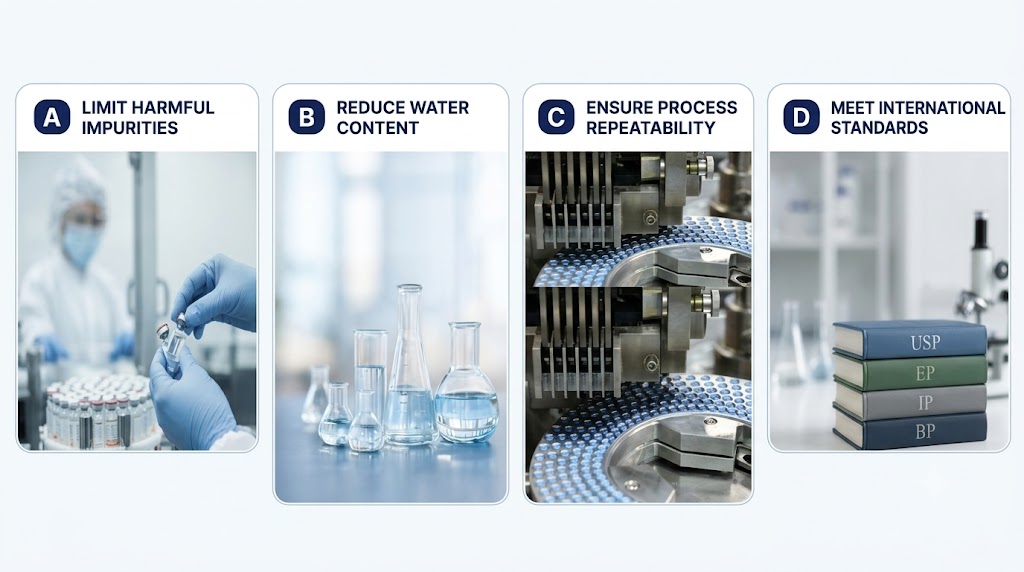
a. Limiting harmful impurities
- Ethanol used in pharmaceuticals must be strictly controlled for impurities such as:
- Methanol.
- Acetaldehyde.
- Fusel oils.
- Benzene.
- Heavy metals.
- Other volatile organic compounds.
- Using high-purity ethanol helps reduce the risk of harmful impurities remaining in the finished product, particularly in oral medicines, injectable products, and preparations intended for children.
b. Reducing water content
- Ethanol at 96–100% contains relatively little water, offering several benefits:
- Limits hydrolysis of active ingredients.
- Improves chemical stability.
- Reduces the risk of microbial growth.
- Improves the solubility of lipophilic substances.
- Enhances extraction efficiency.
- This is particularly important for active ingredients or excipients that are sensitive to moisture.
c. Ensuring reproducibility in manufacturing processes
- Consistent ethanol purity helps maintain process parameters and ensures greater uniformity between production batches, including:
- Solvent capacity.
- Evaporation rate.
- Viscosity.
- Density.
- Wet granulation performance.
- Film-coating quality.
d. Compliance with international pharmacopoeial standards
- Ethanol used in pharmaceutical manufacturing generally needs to comply with the requirements of the following pharmacopoeias: USP, Ph. Eur., BP, and JP.
- These standards establish strict requirements for:
- Identification.
- Ethanol content.
- Impurity limits.
- Methanol limits.
- Water content.
- Residue on evaporation.
- Acidity and alkalinity.
- Other physicochemical parameters.
- Selecting pharmacopoeial-grade ethanol helps pharmaceutical manufacturers meet GMP requirements and international quality management regulations.
Conclusion
High-purity ethanol at 96–100% is an essential raw material in pharmaceutical formulation and manufacturing. Its applications range from dissolving active ingredients and extracting medicinal plants to wet granulation, film coating, advanced drug delivery system development, and disinfection in manufacturing facilities. With its low water content, high purity, and ability to meet international pharmacopoeial standards, pharmaceutical-grade ethanol contributes to the quality, stability, and safety of finished products. Therefore, selecting a compliant ethanol supplier is not only a technical requirement but also an important factor in maintaining consistent manufacturing processes and meeting increasingly stringent quality standards.
Biorich supplies high-purity ethanol grades for pharmaceutical formulation and manufacturing, including:
- Ethanol 96%.
- Ethanol 100%.
These products are supplied with relevant certifications and registration documentation to support compliance with the stringent requirements of international pharmacopoeial standards.