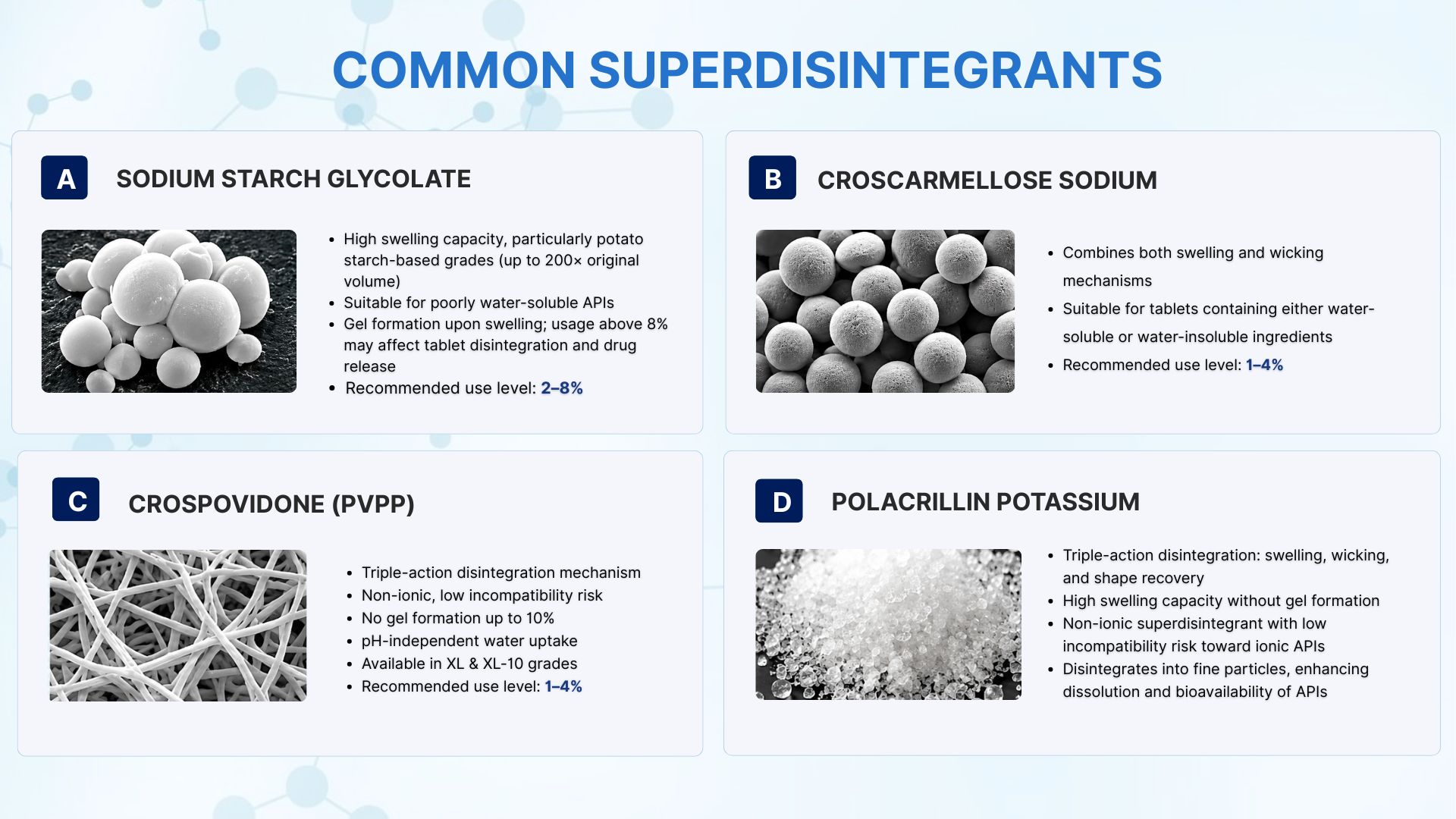
Types of superdisintegrants, mechanisms and applications in pharmaceutical formulation
1. General introduction to superdisintegrants
Superdisintegrants are essential components required in solid dosage forms, serving the following primary roles:
Improving tablet disintegration: Facilitating the breakdown of the tablet matrix upon contact with gastrointestinal fluids.
Enhancing the solubility, dissolution rate, and bioavailability of the active ingredient:Particularly crucial for poorly soluble active pharmaceutical ingredients (APIs).
To effectively fulfill their functions, superdisintegrants should possess the following properties, depending on the dosage form, the API, and the specific manufacturing process utilized:
The excipient draws water into the tablet via capillary action, dissolving the tablet components from within.
deal for formulations containing highly water-soluble ingredients (e.g., lactose, mannitol, sugars, and polyols).
(Shape Recovery)
Upon exposure to water, excipient particles tend to revert to their pre-compression shape, thereby breaking the tablet matrix and facilitating disintegration.
Suitable for most applications, particularly for tablets that are challenging to disintegrate.
Most current superdisintegrants function through a combination of the aforementioned mechanisms to varying extents.
Potassium Bicarbonate from Sujata Nutri-Pharma Pvt. Ltd. (India). High-quality pharmaceutical-grade raw material providing Potassium ions, acting as an acid neutralizer, and serving as a superior effervescent agent for pharmaceutical and health supplement formulations. Contact Biorich today!
Polyvinyl Alcohol (PVA) from Jiangxi Alpha Hi-Tech Pharmaceutical Co., Ltd (China). Premium pharmaceutical-grade raw material, delivering excellent film-forming properties and high adhesion, specialized for tablet film coatings and ophthalmic solutions. Contact Biorich today!
High-quality Polyethylene Oxide raw material from Jiangxi Alpha Hi-Tech Pharmaceutical Co., Ltd (China). An outstanding excipient solution specifically designed for controlled-release tablet formulations and osmotic pump systems. Contact Biorich today!
Polyethylene Glycol ARENTEX PLUS) complies with USP-NF/Ph.Eur standards from manufacturer Aceto Pharma (India). A high-quality liquid excipient and ideal solvent for softgels, liquid dosage forms, and injections. Contact Biorich now!


.jpg)
(1).jpg)
.jpg)