(30).jpg)
When developing dietary supplements, the toughest challenge for an R&D team is rarely finding more ingredients to pack into a label, but rather streamlining the formula while hitting multiple physiological targets effectively. This practical need explains why multifunctional Bromelain enzyme has become a cornerstone ingredient for modern formulators. Extracted from the stem and fruit of the pineapple plant, scientifically classified as Ananas comosus of the Bromeliaceae family, this bioactive belongs to the cysteine protease class yet delivers therapeutic versatility far beyond a conventional digestive aid.
In commercial manufacturing, bromelain utilized in pharmaceuticals and dietary supplements is sourced primarily from pineapple stems rather than the edible fruit pulp. The reason is purely technical: post-harvest stems yield a substantially higher concentration of active enzymes, and stem bromelain, indexed under EC 3.4.22.32, exhibits superior thermal tolerance and broader pH stability compared to fruit bromelain. Biochemically, this raw material is not a single isolated molecule but a complex ensemble of endopeptidases featuring a free thiol group at the catalytic core, accompanied by non-protease fractions including peroxidase, acid phosphatase, natural protease inhibitors, and organically bound carbohydrates.
This native multi-component architecture enables the ingredient to perform both local protein cleavage within the gastrointestinal tract and systemic regulatory actions across the circulatory and respiratory systems upon absorption. A critical rule that every formulation scientist and brand owner must apply during raw material procurement is never to evaluate bromelain solely by milligram weight. True commercial value resides in standardized enzymatic potency measured in Gelatin Digesting Units, abbreviated as GDU, or Milk Clotting Units, abbreviated as MCU. Two raw material lots both declaring 500 mg on a supplement facts panel—one standardized to 2400 GDU per gram and another to 600 GDU per gram—will deliver vastly different clinical outcomes.
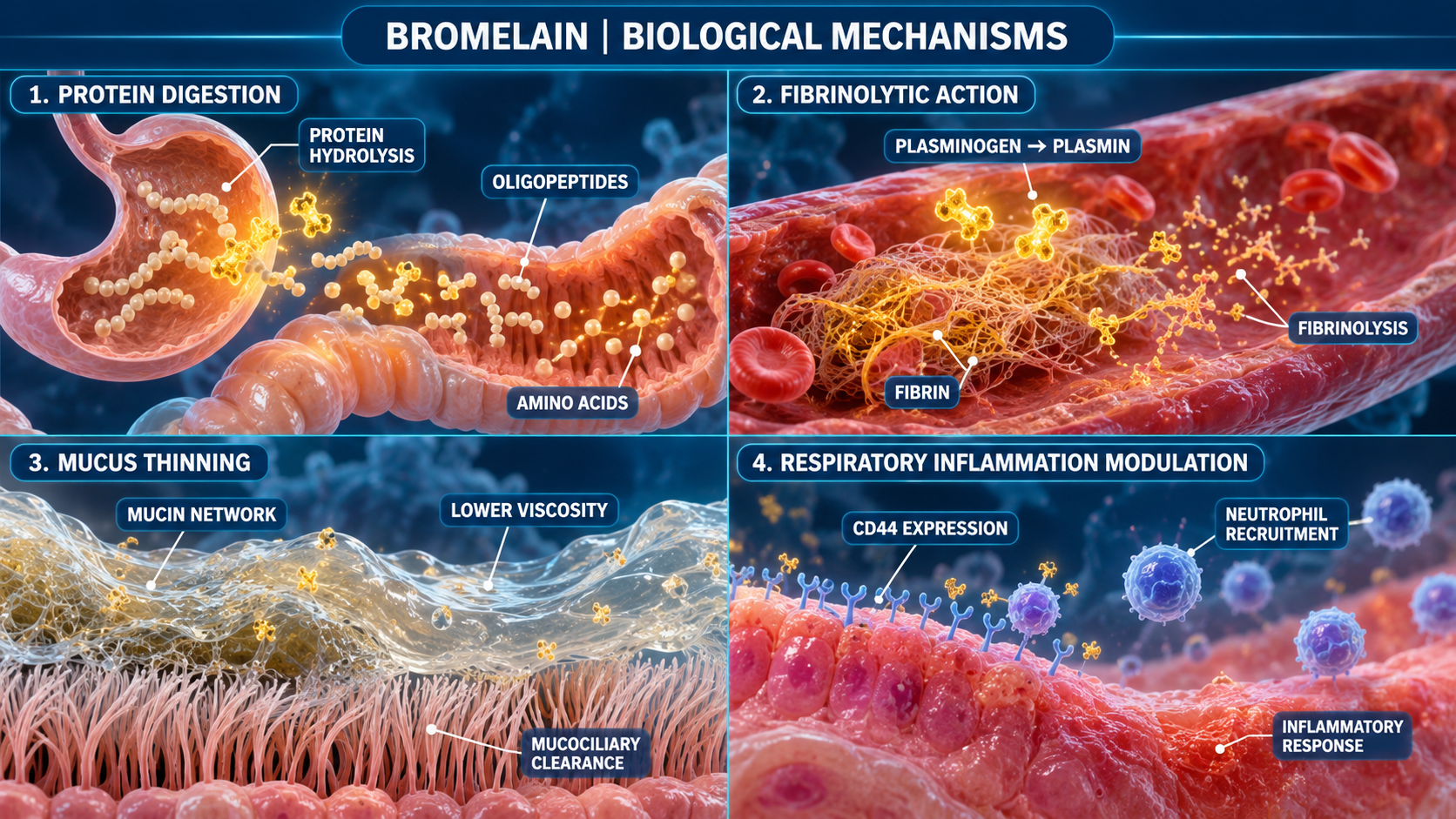
At the molecular level, the catalytic site of this enzyme houses an active dyad composed of cysteine and histidine residues. Upon binding to a protein substrate, the sulfhydryl group of cysteine directly attacks internal peptide bonds, preferentially cleaving sites adjacent to lysine, alanine, tyrosine, and glycine. The mechanism of Bromelain protein hydrolysis systematically breaks bulky polypeptide chains down into short oligopeptides and free amino acids ready for intestinal uptake.
What sets multifunctional Bromelain enzyme apart from endogenous digestive enzymes is its remarkable resilience across shifting pH environments. Whereas gastric pepsin operates exclusively in strongly acidic conditions around pH 1.5 to 2.5 before denaturing in the duodenum, and pancreatic trypsin requires a mildly alkaline environment between pH 7.5 and 8.5, bromelain maintains steady catalytic efficiency across a wide pH window from 3.0 to 8.0. Consequently, it initiates protein breakdown right inside the stomach after a meal and continues working seamlessly as chyme enters the small intestine, significantly easing the secretory workload of the pancreas in individuals with compromised digestion.
When ingested on an empty stomach and properly shielded from gastric acid, a measurable fraction of intact bromelain molecules crosses the small intestinal epithelium into systemic circulation without losing tertiary conformation. Within the bloodstream, fibrin-degrading Bromelain executes a well-documented dual mechanism across the coagulation and fibrinolytic cascades. On one pathway, it stimulates the conversion of inactive plasminogen into free plasmin to clear accumulating fibrin networks. On the parallel pathway, it directly hydrolyzes both fibrin and fibrinogen molecules while suppressing kallikrein precursor synthesis to lower plasma bradykinin and kininogen levels.
Beyond clearing microvascular congestion, experimental pharmacological data demonstrate that this active ingredient modulates eicosanoid balance. Specifically, bromelain downregulates the synthesis of pro-inflammatory and vasoconstrictive prostaglandins such as PGE2 and thromboxane A2, while promoting the formation of prostacyclin PGI2, which encourages vasodilation and curbs excessive platelet aggregation. This coordinated action between fibrin clearance and vascular permeability regulation explains why bromelain is widely incorporated into circulatory support and soft tissue recovery formulations.
Across the upper and lower respiratory tracts, nasal congestion, sinus pressure, and thick bronchial phlegm stem largely from densely cross-linked mucin glycoprotein networks. Leveraging its peptide-cleaving capacity, bromelain severs protein cross-links within viscous mucin matrices, markedly lowering the viscosity of sinonasal and bronchial secretions. Once mucus becomes thinner, the mucociliary escalator along the respiratory epithelium can efficiently clear stagnant secretions, restoring natural airway patency.
Alongside its physical mucolytic action, bromelain modulates localized immune responses. It downregulates the expression of cell-surface adhesion molecule CD44 on leukocytes, thereby curbing excessive neutrophil migration into inflamed sinonasal mucosa. Controlling leukocyte infiltration helps soothe mucosal swelling, facial pressure, and airway irritation without causing the rebound dryness associated with topical decongestants.
When designing products for consumers experiencing bloating and indigestion after protein-heavy meals, the objective of a digestive bromelain enzyme formula is rapid release directly inside the stomach. Immediate-release hard capsules, chewable tablets, or direct-to-mouth sachets taken before or during meals represent the most effective delivery formats. To cover the full macronutrient spectrum, formulators frequently pair bromelain with papain from papaya, fungal proteases from Aspergillus, amylase, lipase, and cellulase to break down proteins, lipids, and carbohydrates concurrently.
However, the biggest manufacturing hurdle for digestive lines is rapid potency loss when processing involves moisture and heat. Bromelain is highly sensitive to free water; even minor moisture ingress triggers enzymatic autolysis, causing GDU assays to plummet before the product reaches retail shelves. For tablet manufacturing, R&D teams should favor direct compression or dry granulation via roller compaction rather than hydro-alcoholic wet granulation. Supporting excipients must exhibit ultra-low water activity, such as anhydrous dicalcium phosphate or low-moisture grade microcrystalline cellulose, to lock out hydrolytic self-degradation throughout shelf life.
In complete contrast to digestive applications, when a formula targets the systemic action of fibrin-degrading Bromelain to support blood flow and vascular health, exposing the enzyme to gastric acid and pepsin will unfold its tertiary structure and destroy biological activity. Formulators must implement enteric tablet coating or utilize specialized acid-resistant hard capsules manufactured from polymers such as hydroxypropyl methylcellulose phthalate or methacrylic acid copolymers. This protective barrier keeps the dosage form intact through the stomach and triggers disintegration only in the duodenum at pH 5.5 and above.
In contemporary cardiovascular support formulas, bromelain is routinely paired with nattokinase, rutin, quercetin, or ginkgo biloba extract to deliver synergistic support for endothelial integrity and blood viscosity. A common formulation trap in this category involves physical incompatibility with herbal extracts rich in tannins or free polyphenols. Tannins exhibit strong binding affinity toward protein structures, forming irreversible precipitates upon direct blending that wipe out enzyme activity during tableting. Effective mitigation requires physical separation via bilayer tableting or utilizing separately microencapsulated bromelain granules.
Within respiratory health supplements targeting phlegm clearance and sinus comfort, multifunctional Bromelain enzyme is commonly formulated into lozenges, enteric-coated tablets, or capsules alongside N-acetylcysteine, ivy leaf extract, echinacea extract, and essential oils such as eucalyptol and menthol. Combining bromelain with N-acetylcysteine yields potent mucolytic synergy clinically, yet introduces a distinct chemical compatibility risk inside the powder blend.
Specifically, N-acetylcysteine carries a free sulfhydryl group with strong reducing potential capable of cleaving disulfide bridges that maintain the three-dimensional folding of bromelain. When exposed to elevated temperatures during blending or compression, this thiol-disulfide exchange accelerates and deactivates the enzyme. Manufacturing protocols for respiratory formulas must therefore maintain compounding room temperatures strictly below 40 degrees Celsius, paired with high-barrier packaging such as cold-formed aluminum blisters or amber glass bottles containing pharmaceutical-grade silica gel desiccants.
Illustration | Brand and Product | Role of the Ingredient |
|---|---|---|
 | NOW Foods | Protein-digesting enzymes support digestive function when taken with food. |
 | Jarrow Formulas | Protein-digesting enzymes, targeted to support protein digestion and joint health. |
| AdvaCare Pharma | Protein-digesting enzymes, marketed by the manufacturer as supporting digestion and gut health. |