Cetostearyl Alcohol – The co-emulsifying excipient for enhanced formulation performance
1. General introduction to Cetostearyl Alcohol
Cetostearyl Alcohol is a mixture of long-chain fatty alcohols consisting of 50–70% stearyl alcohol (C₁₈H₃₈O) and 20–35% cetyl alcohol (C₁₆H₃₄O), with these two components comprising at least 90% of the material (in pharmacopeias). It is widely used in topical pharmaceutical formulations as an emollient, viscosity-enhancing agent, and emulsifying agent. Typically used in combination with primary emulsifying agents, cetostearyl alcohol enhances emulsification efficiency and improves the stability of both oil-in-water (O/W) and water-in-oil (W/O) emulsions, while reducing the amount of primary emulsifier required in the formulation.
Cetostearyl Alcohol is primarily derived from natural waxes and can also be semi-synthesized from fatty acids of vegetable and animal origin. Like most fatty alcohols, it is a solid at room temperature and is generally regarded as non-irritating to the skin. In topical pharmaceutical formulations, cetostearyl alcohol is considered an essential multifunctional excipient; it improves emulsion stability, enhances product texture and sensory attributes, reduces the amount of emulsifier required, and contributes to the development of high-quality topical formulations.
2. Typical properties of Cetostearyl Alcohol
Material Name: Cetostearyl Alcohol
Empirical formula : 50 - 70% C18H37OH (stearyl alcohol) và 20 - 35% C16H33OH (cetyl alcohol)
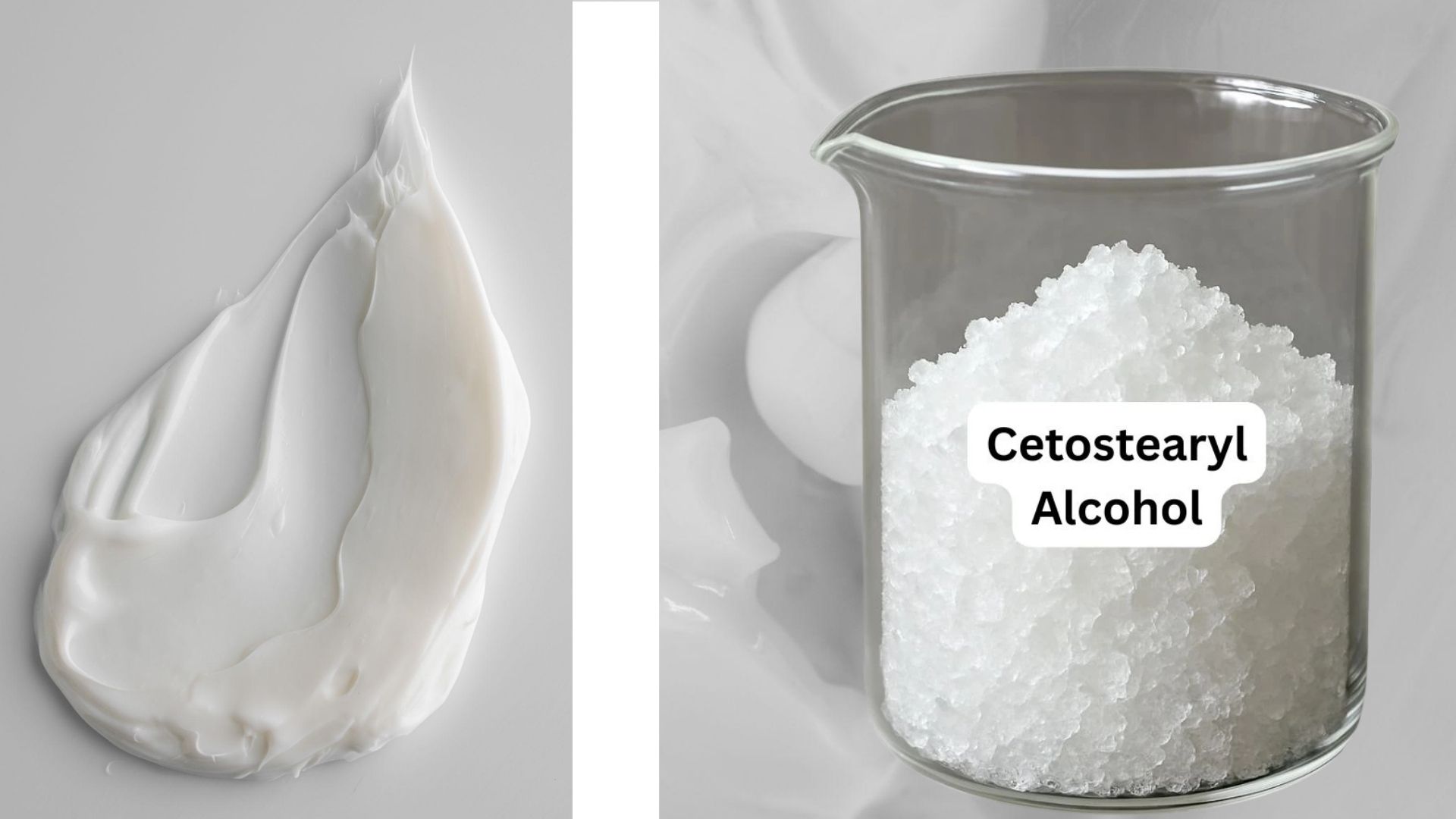
Appearance: occurs as white or cream-colored unctuous masses, flakes, pellets or granules, with a characteristic sweet odor
Soubility: soluble in ethanol (95%), ether, and oil; practically insoluble in water
Density bulk : ~0,80 g/cm3 at 20°C
Melting range : 48 - 56°C (depending on the ratio of stearyl alcohol/cetyl alcohol)
Incompatibilities : Cetostearyl alcohol is incompatible with strong oxidizing agents and metal salts
The material is rigorously controlled for the following parameters:
Identification and assay of stearyl alcohol and cetyl alcohol
Appearance, solubility, and melting range
Iodine value
Acid value
Hydroxyl value
Saponification value
3. Key advantages of Cetostearyl Alcohol
Optimized for Ointment and Cream Formulations:Cetostearyl Alcohol is a multifunctional excipient widely used in topical semisolid formulations, combining three essential functions in a single ingredient: a viscosity-enhancing agent, emollient, and emulsifier/co-emulsifier. This multifunctionality simplifies formulation design, optimizes the manufacturing process, shortens production time, and helps reduce manufacturing costs while maintaining the stability and quality of the finished product.
Excellent Co-emulsifying Performance:is commonly used as a co-emulsifier, significantly enhancing the emulsification efficiency and water-holding capacity of primary emulsifiers, particularly in oil-in-water (O/W) emulsion systems (example: Vaseline). As a result, it improves emulsion stability and enhances the overall physical stability of the finished product.
Excellent Biocompatibility: exhibits excellent compatibility with the skin, with a low potential for irritation and good tolerability in topical formulations. In addition to its emollient properties, it improves skin feel during application and helps maintain the skin's natural barrier function, thereby enhancing patient comfort and product acceptability.
Broad Formulation Compatibility: is highly compatible with a wide range of oils, waxes, emulsifiers, and other pharmaceutical excipients while maintaining formulation stability. This characteristic provides greater flexibility in formulation development, broadens excipient selection options, and supports the development of various semisolid dosage forms, including creams, ointments, and lotions.
4. Applications of Cetostearyl Alcohol
Cetostearyl alcohol is widely used across multiple industries, especially in high-value product segments due to its ability to stabilize formulations and enhance sensory performance:
In pharmaceuticals
Topical creams: provides smooth texture, easy application, and uniform distribution of active ingredients
Ointments: enhances viscosity and adhesion, improving retention time on the skin
Dermatological treatments: stabilizes formulations, prevents separation, and ensures consistent performance throughout shelf life
In premium cosmetics
Skincare creams: creates a rich yet non-greasy texture with good absorption
Lotions: balances fluidity and stability, preventing phase separation over time
Anti-aging products: supports moisture retention and enhances skin feel, delivering a premium user experience
In veterinary applications
Topical treatments: improves adhesion on skin or fur, reducing wash-off and increasing effectiveness
Animal care products:stabilizes formulations for easier use and longer shelf life
5. Commercial products using Cetostearyl Alcohol
6. Product contact information
For more information about Cetostearyl Alcoholsupply, please contact us:
Hotline: +84 (0) 834 560 500
Email: director@biorichgroup.com
Website: www.biorichgroup.com
Sample / COA request: Please contact us via email to receive product samples and the latest Certificate of Analysis (COA).
Stearic Acid raw material from Nitika Pharmaceutical Specialities Pvt. Ltd. (India). Meeting international pharmacopoeia standards, specialized as a lubricant excipient for tablets and a cosmetic emulsifier. Contact Biorich now!
Sodium sulfite PARENTEX PLUS raw material from Aceto Pharma (India). Meeting USP-NF, Ph.Eur, and BP standards, specialized as an antioxidant and preservative for pharmaceuticals and injectables. Contact Biorich now!
Sodium Stearyl Fumarate from Gangwal Healthcare (India). A superior new-generation lubricant excipient that overcomes the disadvantages of Magnesium Stearate, optimizing tablet dissolution and hardness. Contact Biorich now!




.png)
.png)