1. Solutions for Masking Bitter Taste and Improving the Solubility of Botanical Ingredients Using Cyclodextrin
Botanical active ingredients are increasingly used in pharmaceuticals and dietary supplements due to their safety profiles and diverse biological activities. However, many natural compounds, such as flavonoids, terpenoids, alkaloids, polyphenols, and essential oils, face two major challenges:
Low water solubility, which can reduce absorption and bioavailability.
Bitter or unpleasant taste, which affects patient acceptability and treatment adherence, particularly among children and older adults.
In recent years, cyclodextrins, particularly β-cyclodextrin (β-CD), have become widely used excipients for simultaneously improving solubility, enhancing stability, and masking the bitter taste of botanical active ingredients without altering their chemical structures.
2. What Are Cyclodextrin and β-Cyclodextrin?
Cyclodextrins (CDs) are cyclic oligosaccharides composed of glucose units linked by α-1,4-glycosidic bonds. Cyclodextrins are produced through the enzymatic action of cyclodextrin glycosyltransferase (CGTase) on starch.
Types of Cyclodextrins:
- Natural cyclodextrins: Composed of 6, 7, or 8 glucose units, known respectively as α-, β-, and γ-cyclodextrin.
- Alpha Cyclodextrin - an overview | ScienceDirect Topics
- Cyclodextrin derivatives: Modified with substituent groups such as sulfobutyl, hydroxypropyl, or randomly methylated groups. Examples include SBECD, HP-β-CD, and RM-β-CD.
Among these, β-cyclodextrin is one of the most widely used types due to its:
- Cavity size suitable for many botanical active ingredients.
- Reasonable cost.
- Established large-scale manufacturing processes.
- High safety profile.
3. Mechanisms of Solubility Enhancement and Bitter Taste Masking by β-Cyclodextrin
β-Cyclodextrin has a ring-shaped molecular structure with two distinctive features:
- The outer surface contains numerous hydroxyl groups, making it hydrophilic.
- The inner cavity provides a relatively hydrophobic environment.
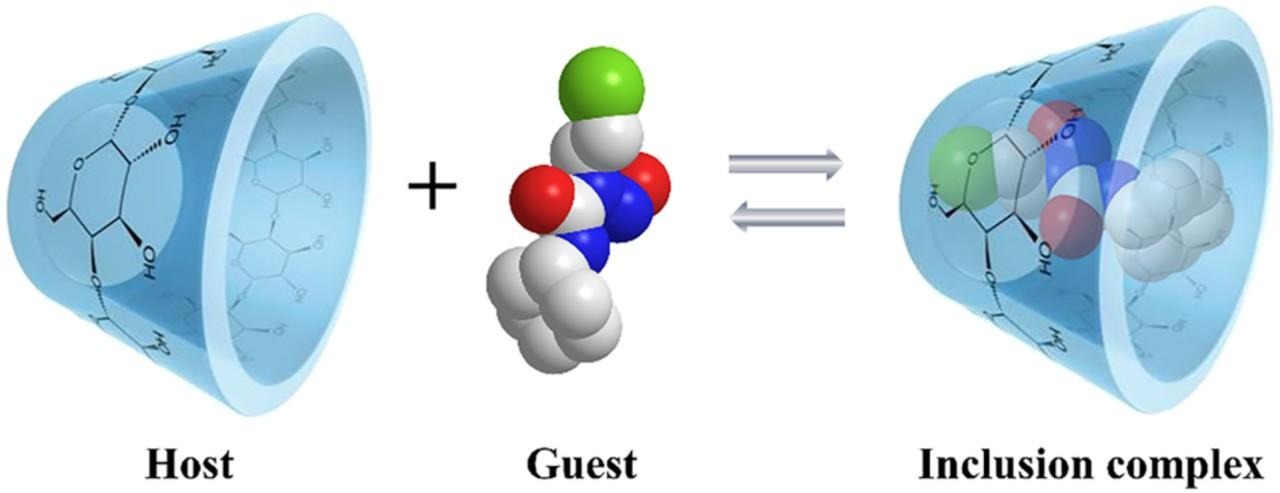
- These structural characteristics enable inclusion complex formation through host–guest interactions. When a molecule with a suitably sized and shaped hydrophobic region encounters β-cyclodextrin, an inclusion complex can form through non-covalent interactions, including Van der Waals forces, hydrophobic interactions, hydrogen bonding, and dipole interactions.
- The Art of Cyclodextrin Complex Formation
- This process is reversible and does not alter the chemical structure of the active ingredient. The results include:
- Improved solubility: Through host–guest complex formation, poorly soluble active ingredients can be incorporated into the cavity of β-cyclodextrin. This can improve their apparent hydrophilicity, reduce the energy required for dissolution, and promote better dispersion in aqueous media.
- Enhanced bioavailability: β-Cyclodextrin inclusion complexes can improve the dissolution rate and dispersion of certain active ingredients, increasing their contact with gastrointestinal fluids and potentially improving oral bioavailability.
- Bitter taste masking: Hydrophobic groups associated with bitter taste can be accommodated within the β-cyclodextrin cavity. This may reduce the amount of free active ingredient available to interact with bitter taste receptors, thereby reducing the perception of bitterness.
- Reduced or prevented irritation caused by certain active ingredients, potentially minimizing undesirable effects.
- Reduced interactions between active ingredients and other active ingredients or excipients.
- Protection of active ingredients and formulation stabilization: Helps limit oxidation, reduce the effects of temperature and light on degradation, and minimize evaporation of volatile active ingredients.
- Prevention of recrystallization: Many natural compounds tend to recrystallize after dissolution. Complex formation with β-cyclodextrin can help inhibit recrystallization and maintain the active ingredient in a dissolved or less crystalline state for longer, depending on the compound and formulation conditions.
4. Applications of β-Cyclodextrin in Botanical Dosage Forms
β-Cyclodextrin is used to mask bitter taste and improve the solubility and bioavailability of various botanical compounds, including flavonoids, polyphenols, terpenoids, essential oils, alkaloids, and herbal extracts.
Methods for Forming Complexes Between β-Cyclodextrin and Active Ingredients:
- Kneading method: β-Cyclodextrin is moistened with water or an ethanol–water mixture to form a paste. The active ingredient is then added, and the mixture is kneaded continuously for approximately 30–60 minutes. The resulting material is dried, milled, and sieved to obtain a powdered complex.
- Dry grinding method: A ball mill or high-energy mill is used for several hours to promote complex formation and produce a powder.
- Spray-drying method: A solution containing β-cyclodextrin is combined with a solution of the active ingredient and stirred to promote complex formation. The mixture is then processed using a spray dryer or fluid-bed granulator to obtain a powder.
- Freeze-drying method: The solution containing the formed complex is frozen, followed by sublimation of the ice under reduced pressure.
- Ultrasonication method: Ultrasound waves are used to facilitate mixing and promote complex formation.
- The typical molar ratio of β-cyclodextrin to the active ingredient is 1:1. However, some active ingredients may require ratios of 1:2 or 2:1.
5. Advantages of Using β-Cyclodextrin for Botanical Active Ingredients
Botanical active ingredients often lack ionizable functional groups, making certain conventional taste-masking methods, such as complexation with ion-exchange resins, unsuitable. β-Cyclodextrin complex formation is not determined solely by the chemical structure of the active ingredient; it also depends on molecular size, shape, hydrophobicity, and the ability of the molecule to fit into the cyclodextrin cavity. As a result, β-cyclodextrin can form inclusion complexes with a wide range of botanical compounds, potentially improving solubility and masking unpleasant tastes.
In addition, β-cyclodextrin offers several advantages:
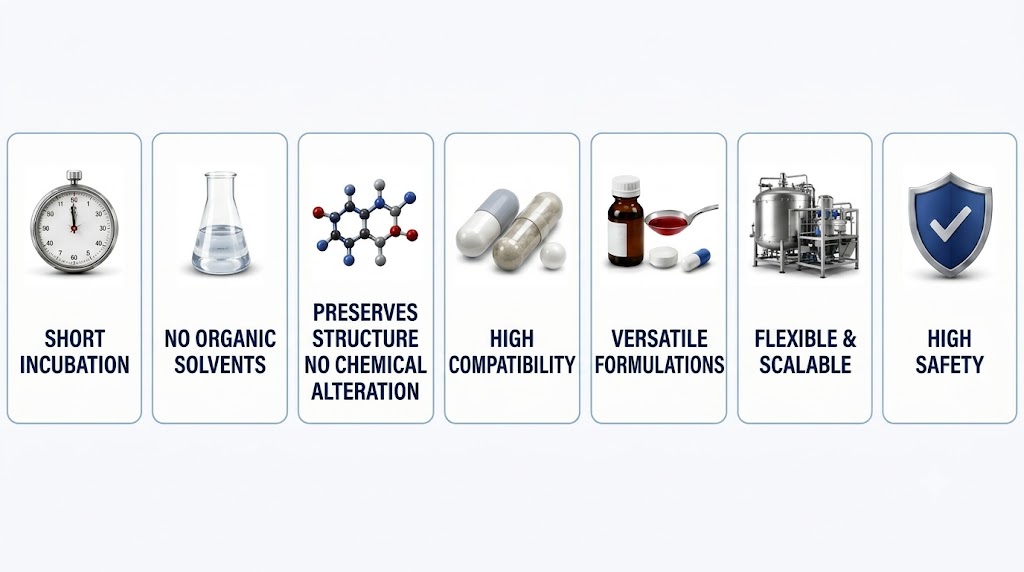
- Short complexation time, often within a few hours.
- No requirement for organic solvents in certain preparation methods, helping reduce residual solvent concerns and fire hazards.
- Does not chemically modify the active ingredient or necessarily alter its biological activity.
- Compatible with many active ingredients and excipients.
- Suitable for various solid and liquid dosage forms and multiple classes of botanical compounds.
- Flexible formulation and manufacturing processes that can be scaled up.
- Favorable safety profile when used at appropriate levels and in accordance with applicable regulatory requirements.